
 |
| Richard Wathen on linen, on aluminium, (diptych), 230 x 180 cm (each panel). www.maxwigram.com |
Wednesday, October 10, 2012
Richard Wathen


Sunday, September 30, 2012
+by+Robert+and+Shana+ParkeHarrison.jpg)
Friday, September 28, 2012
Marie Sauvaitre
 |
| Marie Sauvaitre, Slab City, USA, 2005 Reflecting on globalization, mobility and the new roles of borders, ERRANCES - French term for something between exile and wandering - explores and pays homage to nomads home through color landscape photographs. |
Monday, September 24, 2012
Megan Lowney
 |
| "My first successful 4x5 negative of senior year" Megan Lowney, NHIA (smart phone image} |

Sunday, September 23, 2012


Monday, September 3, 2012
Urs Fischer
 |
| Urs Fischer, Untitled, 2011, wax, pigments, wicks, steel. On view in the 2011 Venice Biennale Read More |
Monday, August 27, 2012
Ester Bubley
 |
| April 1943. Washington, D.C. "Girl sitting alone in the Sea Grill waiting for a pickup. 'I come in here pretty often, sometimes alone, mostly with another girl, we drink beer, and talk, and of course we keep our eyes open -- you'd be surprised at how often nice lonesome soldiers ask Sue, the waitress, to introduce them to us.' " Medium-format nitrate negative by Esther Bubley for the OWI. (note face in window above woman's head) |
Sunday, August 19, 2012
8"X10" VIEW
 |
The Power of the 8-by-10 Film CameraIn this weekend’s magazine, Lizzy Goodman writes about Gaslight Anthem, a band from New Jersey, on the occasion of its new release this week. To illustrate Goodman’s story, George Tice photographed the band using a large-format, 8-by-10 film camera. Tice speaks about his love for his camera, which he bought new in 1969, in a video on our Web site. |
Wednesday, August 8, 2012

Saturday, August 4, 2012
Julee Holcombe
 | ||||||||||||||||||||||||||||||||||||||||||||||||||||||||||||||||||||||||||||||||||||||||||||||||||||||||||||||||
| "Among the River of Ghosts" Made in Chimerica*, August 3 - August 24, 2012 Collaged Photographs by Julee Holcombe The Parlor at Planspoke 18 Sheefe Street Portsmouth, NH 03801 *Must see! |
Thursday, August 2, 2012
Daniel Kukla
 |
Driving in the desert inspired Daniel Kukla to haul enormous mirrors into Joshua Tree National Park and photograph contrasts of landscape and sky."Life on the Desert’s Edge" New York Times by JESSE NEWMAN |
Wednesday, July 25, 2012
Sixth Finch
 |
| Sixth Finch is an online journal of poetry and art, founded in 2008 and
updated quarterly. We are committed to bringing the best in contemporary
art and poetry to our readers at no cost. Cover art: "Cluster" by Jeremy Gedes |


Saturday, July 14, 2012
Flakphoto.com
 |
The CollectionSophie T. LvoffCarrollton Avenue , New Orleans, 2011From the Hell’s Bells / Sulfur / Honey series Website - SophieLvoff.com |
Friday, July 13, 2012


Friday, July 6, 2012

Saturday, June 30, 2012
Lu Cong

 |
| Lu Cong was born in Shanghai, in February 1978. He immigrated to the United States in 1989 at the age of 11. After graduating from the University of Iowa with degrees in Biology and Art in 2000, Lu chose to pursue portrait art over medicine. His early works were large and sensational, though they were painted with exaggerated melodrama and pathos, his keen insight and sensitivity towards his subjects were nonetheless evident. Between 2003 and 2007, Lu was recognized by a number of art publications as a notable emerging artist. Since then, Lu has developed a distinctive look that many has regarded as an original approach to figurative realism. His portraits do not simply capture the physical or emotional likeness of the subject, rather they beckon to establish an authentic engagement - interaction that ensues when one comes face to face with the sensual, the inexplicable, and the unsettling. |
Tuesday, June 26, 2012
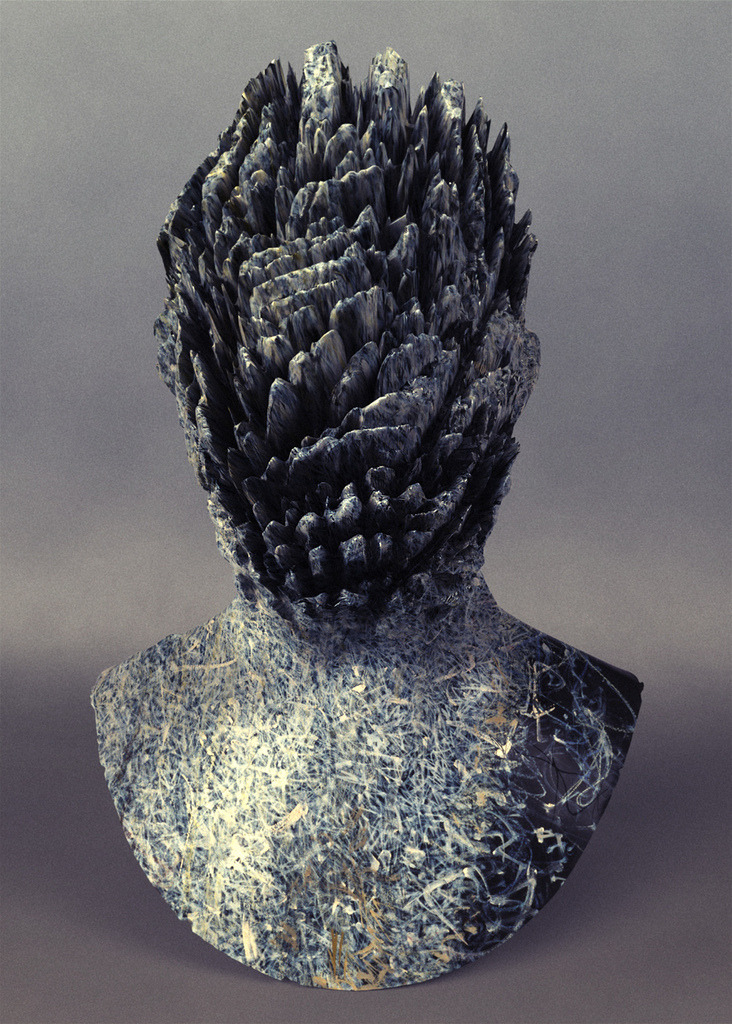
Tuesday, May 15, 2012
St. Dennistoun Mortuary
 |
| "St. Dennistoun Mortuary" Coin-Operated Automaton, Attributed to Leonard Lee, c. 1900, Skinner Auctioneers, June 2, 2012 via Morbid Anatomy |
Wednesday, April 11, 2012
Trash Art by Meika Jensen
 |
|
Trash Takes
Museums by Storm
Meika
Jensen
Sustainability
haunts every classroom in this country. Everyone, from those in accredited
masters degree programs to kindergarten students, are discussing the
issue and making changes both lifestyle and policy changes. The art community
is no different. Charged with showing the world a picture of itself,
capturing the very essence of life, in a day and age plagued by waste and
plastic it is no wonder that artists are turning to trash for inspiration.
A shiny
chandelier is constructed of worn out kitchen pipes. Children inspect
sculptures of mythological horses crafted from plastic bottles. Disco balls
made entirely of metal cans and shreds of paper towels. All of these bits
and scraps of trash and rubbish represent faces of a new movement that is
taking place in at the forefront of the art world. The movement originates from
deep inside the plastic
arts community and is all about taking regular recyclable materials,
as well as those that are reusable not but exactly recyclable, and turning them
into functional everyday reproducible objects.
Stepping away from the idea that art should be made for art’s sake,
these artists are spreading a greater global message - the ability to turn
weaknesses into strengths by changing the aesthetics of ugly. The current
driving idea in eco-art is that of transformation of trash
into something functional as well as visually stunning.
Using trash in the material for art was a launch pad for the new
artists. Today, people are not as shocked at this trend as they were at the
beginning; artists have succeeded in incorporating repurposed materials into
the acceptable realm of materials and concepts. Whether they are making a house
out of bottles or calling a urinal a fountain, yesterday’s waste is tomorrow
masters degree program fodder.
More and more artists are preoccupied by the ecological impact of
waste and the significance of a throw away culture. Artistic manifestos seem to
make their way into the woods as well; since Thoreau wrote Walden and Native
art broke into mainstream museums, artists have kept it on their radar.
The answer of
the artistic community to the new wave of trash-art is a rather warm one.
There are some traditional painters who cannot accept that a tree made of
plastic has the same artistic value as a tree painted by Rembrandt, Degas,
Monet or Mondrian. However, most artists themselves recognize the fact that
today’s over-consumption model is not viable and needs a major redesign,
continuing the tradition of portraiture and consumption wouldn’t be breaking
any norms.
The future will probably see the most compelling pieces exposed
somewhere in a museum buried in a landfill. Projects of this kind are already
in place in San Diego, according to the University of
California’s Institute of Research in the Arts. Other projects will
probably be formatted as creative workshops and short-term expositions moving
from one part of the country to another. The public seems to be the winner, as
the new generation of artists who believe in recycling can serve as a moral
model to the even younger generations who are sure to follow.
However, if art ever repeats itself, it is only in the sense that
norms will be broken. Once trash art is ubiquitous, it will go the way of
marble sculptures.
|
Subscribe to:
Posts (Atom)


.jpg)

.jpg)


.jpg)


